Ethics in women’s health technology is an underrepresented subject.
Over the past decade, FemTech has evolved from a niche startup category into a rapidly expanding sector within digital health. Today, the ecosystem includes a wide range of women’s health technology, from fertility tracking apps and menopause support platforms to pelvic health devices, hormonal monitoring wearables, and AI-assisted diagnostic tools.
This surge of innovation reflects a long-overdue shift. For many years, women’s health needs were underrepresented in medical research, healthcare product design, and digital health innovation. FemTech aims to correct that imbalance by creating technologies specifically designed around female biology and lived experience.
However, just because a technology exists, does it mean it should exist in its current form?
Many FemTech products successfully gather data, track symptoms, or generate predictions using algorithms and wearable sensors. These capabilities represent meaningful technological progress. Yet technology alone does not automatically translate into better healthcare outcomes.
From my observation there is often a gap between what technology is capable of building and what women actually need from their healthcare tools.
For founders and developers, this gap highlights the importance of designing ethical femtech solutions that go beyond data collection and prioritize meaningful health outcomes. For clinicians, it raises questions about how digital tools can complement rather than replace evidence-based medical care. And for users, it underscores the need for transparency about what a product can realistically deliver.
What technologies can we build for women’s health but also what technologies improve women’s health and well-being?
Understanding the Is-Ought Problem
The is-ought problem or Hume’s guillotine, was posed by David Hume. He discusses the flaw in assuming that the facts of a matter mean that it should be as such. He observed in A Treatise of Human Nature that people often move too quickly from describing what exists to deciding what should exist.
He argued that “ought” introduces a new dimension to a problem that cannot simply be prescribed based on what is. We must separate the domain of facts from the domain of values. There is a gap in the reasoning.
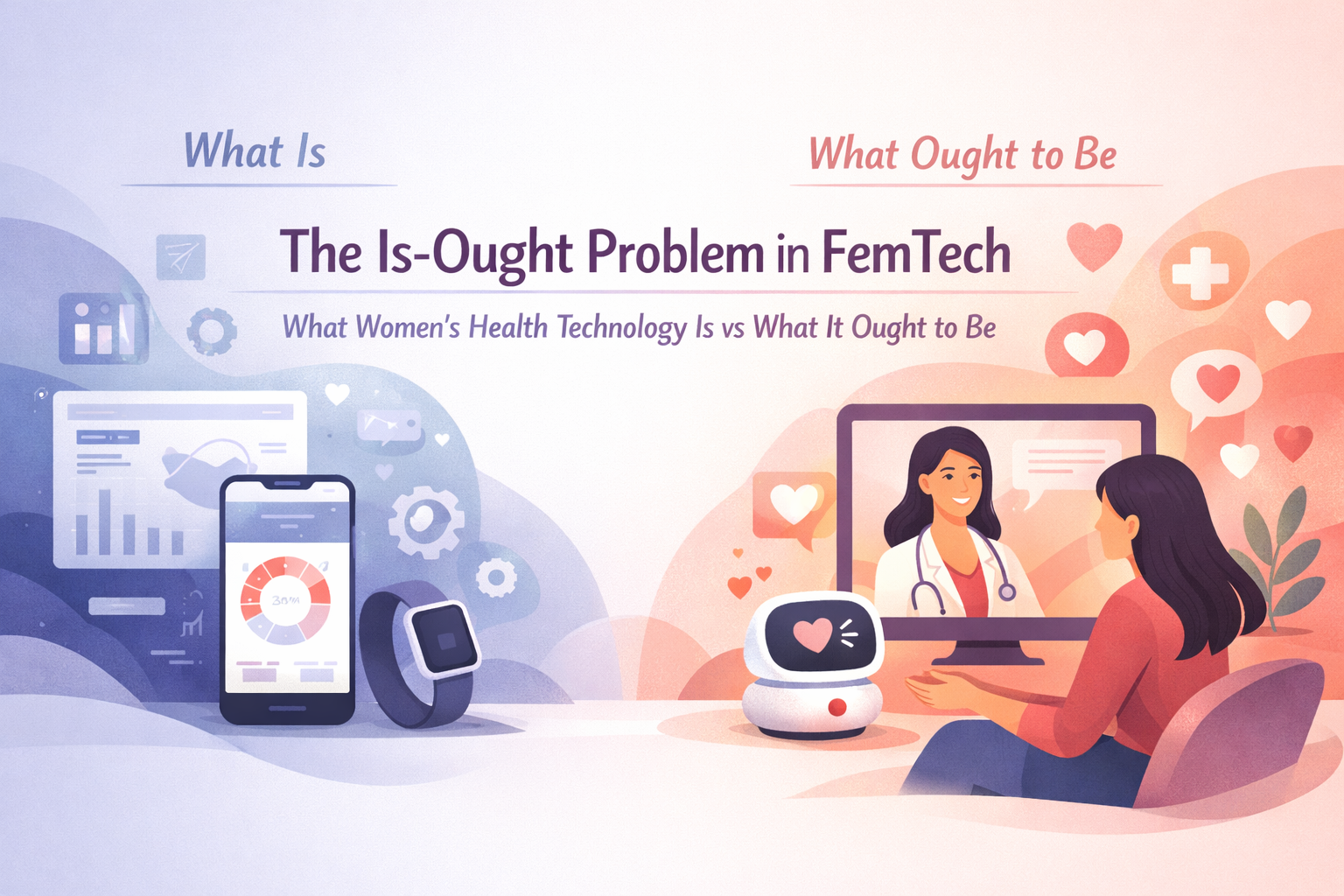
The “Is” describes how things currently are. It refers to the reality of a situation. What technologies exist, how products are designed, and how they are currently used.
The “Ought” describes how things should ideally be. It reflects our expectations, ethical standards, and the outcomes we believe technology should deliver.
The challenge arises when we assume that progress in technology automatically means improvement in health outcomes.
In many industries, innovation is often celebrated simply because it is new, faster, or more advanced. However, technology alone does not guarantee better care, better decisions, or better protection for users.
Another argument that arises is, should we continue to develop and use technology simply because the world is more digital today?
What FemTech Is Today
The FemTech sector now includes a diverse range of products and services focused on improving women’s health outcomes. Many of these innovations are designed to address conditions or life stages that have historically received limited attention in traditional healthcare systems.
Some of the most visible areas of growth include:
patients and users
healthcare professionals
ethicists and policymakers
public health experts
These perspectives help ensure that new technologies are evaluated not only for their technical capabilities but also for their social and ethical impact.
Implementation Science
While ethical principles provide important guidance, they must ultimately be translated into practical design decisions. This is where implementation science becomes valuable.
Implementation science focuses on turning high-level ethical commitments into concrete technical practices that can be integrated into product development.
For example, if a FemTech company commits to protecting user privacy, implementation science helps translate that goal into measurable actions such as:
data minimization, collecting only the information necessary for the product to function
strong encryption, protecting sensitive reproductive health data from unauthorized access
differential privacy techniques, which allow data analysis while reducing the risk of identifying individual users
These practical safeguards help ensure that ethical commitments are not merely statements of intention but embedded features of the technology itself.
The Core Lesson for FemTech
The Is–Ought problem offers an important reminder for the FemTech industry. Technical innovation alone does not determine whether a technology improves healthcare.
If developers justify decisions solely by pointing to facts—such as available data, algorithm efficiency, or market demand—they risk ignoring the ethical values that should guide women’s health technology.
Instead, the future of FemTech depends on making those values explicit.
Only by clearly articulating what women’s health technology ought to achieve can the industry ensure that innovation truly benefits the people it aims to serve.
Does This Solve the Is–Ought Problem?
The frameworks discussed above—Value-Sensitive Design, Responsible Research and Innovation, and implementation science—provide powerful tools for improving how technology is designed. They encourage developers to think more carefully about privacy, fairness, healthcare outcomes, and the broader social impact of innovation.
However, it is important to recognize that these approaches do not conclusively solve the Is–Ought problem.
The challenge identified by David Hume is ultimately a logical and philosophical limitation. No amount of technical data, engineering skill, or algorithmic efficiency can automatically tell us what we ought to do. Facts about technology—what it can do, how efficient it is, or how much data it can process—cannot by themselves determine ethical decisions.
In other words, better engineering cannot eliminate the need for moral judgment.
Frameworks such as Value-Sensitive Design help technologists make those judgments more explicit. Instead of assuming that technological capability justifies innovation, these approaches encourage teams to clearly identify the values that guide their decisions. For example, a FemTech company may decide that protecting reproductive data privacy, supporting clinical accuracy, or expanding access to women’s healthcare are core priorities.
But those priorities do not emerge from the technology itself. They come from human values, social debate, and ethical reflection.
This is why the Is–Ought problem remains relevant for women’s health technology. Even as FemTech becomes more sophisticated—with advanced algorithms, wearable sensors, and AI-driven diagnostics—the central question does not disappear:
What should these technologies ultimately be designed to achieve for women’s health?
The answer cannot be found solely in code, datasets, or market demand. It must be determined through ongoing conversations between technologists, healthcare professionals, policymakers, and the women whose lives these tools are meant to support.
Rather than offering a final solution, the value of these ethical frameworks is that they keep the question visible. They remind innovators that technology development is never purely technical—it is also a moral and social decision.
For the FemTech industry, this realization may be one of the most important lessons of all. Technical innovation can expand what is possible, but it is our shared values that determine what should be built and how it should serve women’s health.
Does this technology respect women’s privacy?
Does it provide clinically responsible guidance?
Does it support healthcare access or try to replace it?
Does it meet the real pain points women face or does it simply mask them?
Does it treat users with fairness and dignity?
Answering these questions requires clearly identifying the values that should guide the development of ethical FemTech solutions. It cannot be assumed that technology is inherently beneficial; innovators must actively decide what outcomes they want their products to support.
Emerging Approaches to Ethical Technology Design
Recognizing the Is–Ought gap in technology has encouraged researchers, engineers, and policymakers to develop new frameworks for building technology more responsibly.
In the context of FemTech and women’s health technology, these frameworks are particularly important. Digital tools that track reproductive health, hormonal changes, or sensitive personal data must be designed with clear ethical priorities from the start.
Several approaches have emerged to help developers and founders integrate these values into the innovation process.
Value-Sensitive Design
Value-Sensitive Design (VSD) is an approach to technology development that integrates ethical values, such as privacy, accessibility, autonomy, and fairness, directly into the engineering process.
Engineers and designers identify the values that matter to users early in the development process and incorporate them into the structure of the technology itself.
Responsible Research and Innovation
This approach encourages technologists to expand the development process beyond engineers and investors by including a wider range of stakeholders. In practice, this means involving:
patients and users
healthcare professionals
ethicists and policymakers
public health experts
These perspectives help ensure that new technologies are evaluated not only for their technical capabilities but also for their social and ethical impact.
Implementation Science
While ethical principles provide important guidance, they must ultimately be translated into practical design decisions. This is where implementation science becomes valuable.
Implementation science focuses on turning high-level ethical commitments into concrete technical practices that can be integrated into product development.
For example, if a FemTech company commits to protecting user privacy, implementation science helps translate that goal into measurable actions such as:
data minimization, collecting only the information necessary for the product to function
strong encryption, protecting sensitive reproductive health data from unauthorized access
differential privacy techniques, which allow data analysis while reducing the risk of identifying individual users
These practical safeguards help ensure that ethical commitments are not merely statements of intention but embedded features of the technology itself.
The Core Lesson for FemTech
The Is–Ought problem offers an important reminder for the FemTech industry. Technical innovation alone does not determine whether a technology improves healthcare.
If developers justify decisions solely by pointing to facts—such as available data, algorithm efficiency, or market demand—they risk ignoring the ethical values that should guide women’s health technology.
Instead, the future of FemTech depends on making those values explicit.
Only by clearly articulating what women’s health technology ought to achieve can the industry ensure that innovation truly benefits the people it aims to serve.
Does This Solve the Is–Ought Problem?
The frameworks discussed above—Value-Sensitive Design, Responsible Research and Innovation, and implementation science—provide powerful tools for improving how technology is designed. They encourage developers to think more carefully about privacy, fairness, healthcare outcomes, and the broader social impact of innovation.
However, it is important to recognize that these approaches do not conclusively solve the Is–Ought problem.
The challenge identified by David Hume is ultimately a logical and philosophical limitation. No amount of technical data, engineering skill, or algorithmic efficiency can automatically tell us what we ought to do. Facts about technology—what it can do, how efficient it is, or how much data it can process—cannot by themselves determine ethical decisions.
In other words, better engineering cannot eliminate the need for moral judgment.
Frameworks such as Value-Sensitive Design help technologists make those judgments more explicit. Instead of assuming that technological capability justifies innovation, these approaches encourage teams to clearly identify the values that guide their decisions. For example, a FemTech company may decide that protecting reproductive data privacy, supporting clinical accuracy, or expanding access to women’s healthcare are core priorities.
But those priorities do not emerge from the technology itself. They come from human values, social debate, and ethical reflection.
This is why the Is–Ought problem remains relevant for women’s health technology. Even as FemTech becomes more sophisticated—with advanced algorithms, wearable sensors, and AI-driven diagnostics—the central question does not disappear:
What should these technologies ultimately be designed to achieve for women’s health?
The answer cannot be found solely in code, datasets, or market demand. It must be determined through ongoing conversations between technologists, healthcare professionals, policymakers, and the women whose lives these tools are meant to support.
Rather than offering a final solution, the value of these ethical frameworks is that they keep the question visible. They remind innovators that technology development is never purely technical—it is also a moral and social decision.
For the FemTech industry, this realization may be one of the most important lessons of all. Technical innovation can expand what is possible, but it is our shared values that determine what should be built and how it should serve women’s health.
What data is collected from users
How predictions and health insights are presented
What risks or uncertainties are communicated
How sensitive reproductive data is stored and protected
These design choices shape user behavior, expectations, and trust in the technology. In other words, the values embedded in the design process directly influence the real-world impact of the product.
Bridging the Gap Between What FemTech Is and What It Ought to Be
The Is–Ought gap in technology reminds us that technical capability alone cannot determine what technologies should exist or how they should be used.
In the context of FemTech, this means that building sophisticated tools for cycle tracking, hormone monitoring, or reproductive health analytics does not automatically guarantee that these tools improve women’s health outcomes.
Because of this, bridging the gap between what women’s health technology is today and what it ought to become requires intentionally introducing ethical values into the design process.
In practice, this means expanding the questions that founders, engineers, and healthcare innovators ask when developing new products. Instead, we must go beyond the question of “Can we build this technology?”
For example:
Does this technology respect women’s privacy?
Does it provide clinically responsible guidance?
Does it support healthcare access or try to replace it?
Does it meet the real pain points women face or does it simply mask them?
Does it treat users with fairness and dignity?
Answering these questions requires clearly identifying the values that should guide the development of ethical FemTech solutions. It cannot be assumed that technology is inherently beneficial; innovators must actively decide what outcomes they want their products to support.
Emerging Approaches to Ethical Technology Design
Recognizing the Is–Ought gap in technology has encouraged researchers, engineers, and policymakers to develop new frameworks for building technology more responsibly.
In the context of FemTech and women’s health technology, these frameworks are particularly important. Digital tools that track reproductive health, hormonal changes, or sensitive personal data must be designed with clear ethical priorities from the start.
Several approaches have emerged to help developers and founders integrate these values into the innovation process.
Value-Sensitive Design
Value-Sensitive Design (VSD) is an approach to technology development that integrates ethical values, such as privacy, accessibility, autonomy, and fairness, directly into the engineering process.
Engineers and designers identify the values that matter to users early in the development process and incorporate them into the structure of the technology itself.
Responsible Research and Innovation
This approach encourages technologists to expand the development process beyond engineers and investors by including a wider range of stakeholders. In practice, this means involving:
patients and users
healthcare professionals
ethicists and policymakers
public health experts
These perspectives help ensure that new technologies are evaluated not only for their technical capabilities but also for their social and ethical impact.
Implementation Science
While ethical principles provide important guidance, they must ultimately be translated into practical design decisions. This is where implementation science becomes valuable.
Implementation science focuses on turning high-level ethical commitments into concrete technical practices that can be integrated into product development.
For example, if a FemTech company commits to protecting user privacy, implementation science helps translate that goal into measurable actions such as:
data minimization, collecting only the information necessary for the product to function
strong encryption, protecting sensitive reproductive health data from unauthorized access
differential privacy techniques, which allow data analysis while reducing the risk of identifying individual users
These practical safeguards help ensure that ethical commitments are not merely statements of intention but embedded features of the technology itself.
The Core Lesson for FemTech
The Is–Ought problem offers an important reminder for the FemTech industry. Technical innovation alone does not determine whether a technology improves healthcare.
If developers justify decisions solely by pointing to facts—such as available data, algorithm efficiency, or market demand—they risk ignoring the ethical values that should guide women’s health technology.
Instead, the future of FemTech depends on making those values explicit.
Only by clearly articulating what women’s health technology ought to achieve can the industry ensure that innovation truly benefits the people it aims to serve.
Does This Solve the Is–Ought Problem?
The frameworks discussed above—Value-Sensitive Design, Responsible Research and Innovation, and implementation science—provide powerful tools for improving how technology is designed. They encourage developers to think more carefully about privacy, fairness, healthcare outcomes, and the broader social impact of innovation.
However, it is important to recognize that these approaches do not conclusively solve the Is–Ought problem.
The challenge identified by David Hume is ultimately a logical and philosophical limitation. No amount of technical data, engineering skill, or algorithmic efficiency can automatically tell us what we ought to do. Facts about technology—what it can do, how efficient it is, or how much data it can process—cannot by themselves determine ethical decisions.
In other words, better engineering cannot eliminate the need for moral judgment.
Frameworks such as Value-Sensitive Design help technologists make those judgments more explicit. Instead of assuming that technological capability justifies innovation, these approaches encourage teams to clearly identify the values that guide their decisions. For example, a FemTech company may decide that protecting reproductive data privacy, supporting clinical accuracy, or expanding access to women’s healthcare are core priorities.
But those priorities do not emerge from the technology itself. They come from human values, social debate, and ethical reflection.
This is why the Is–Ought problem remains relevant for women’s health technology. Even as FemTech becomes more sophisticated—with advanced algorithms, wearable sensors, and AI-driven diagnostics—the central question does not disappear:
What should these technologies ultimately be designed to achieve for women’s health?
The answer cannot be found solely in code, datasets, or market demand. It must be determined through ongoing conversations between technologists, healthcare professionals, policymakers, and the women whose lives these tools are meant to support.
Rather than offering a final solution, the value of these ethical frameworks is that they keep the question visible. They remind innovators that technology development is never purely technical—it is also a moral and social decision.
For the FemTech industry, this realization may be one of the most important lessons of all. Technical innovation can expand what is possible, but it is our shared values that determine what should be built and how it should serve women’s health.
Wellness platforms that combine cycle tracking with lifestyle recommendations
Subscription-based health coaching, offering personalized advice related to nutrition, hormones, and symptom management
Direct-to-consumer diagnostics, where users can order at-home hormone tests or health screenings without visiting a clinic
This model makes women’s health tools more accessible and convenient, particularly for people who may face barriers to traditional healthcare systems. Digital platforms can offer educational resources, symptom tracking, and community support in ways that were not previously available.
The Hidden Assumptions Behind FemTech Innovation
The Is–Ought problem in technology becomes clearer when we examine the assumptions that often guide product development in FemTech.
In many cases, the conversation moves quickly from what technology can do to what it should do. This shift may seem natural, but it can hide important ethical questions about how women’s health technology is designed, deployed, and used.
When innovators focus primarily on technical capability, several common assumptions tend to appear. Recognizing these patterns is essential for anyone involved in responsible FemTech design.
The “Can Implies Ought” Fallacy
One of the most common assumptions in technology development is the belief that if something can be built, it should be built.
In FemTech, this often happens when new digital tools make it possible to collect increasingly detailed reproductive health data. Mobile apps, wearable devices, and connected sensors can now track menstrual cycles, hormone patterns, sleep data, and lifestyle habits with remarkable precision.
Because these capabilities exist, companies may assume that building more advanced tracking platforms automatically benefits users. However, technical feasibility does not automatically mean a technology improves health outcomes.
For example, collecting detailed reproductive data can help users notice patterns in their health. But without clear medical interpretation, strong privacy protections, and transparent limitations, more data does not necessarily lead to better healthcare decisions.
The Technological Determinism Trap
Another hidden assumption is the idea that technological progress is inevitable.
Once a new capability exists—such as AI-assisted diagnostics, predictive fertility algorithms, or hormone-monitoring wearables—it can feel as though its widespread adoption is unavoidable. This perspective is known as technological determinism, the belief that technological change naturally drives social change.
However, technology is not a force of nature. It is the result of human decisions made by founders, engineers, investors, regulators, and healthcare professionals.
The “Technology Is Neutral” Argument
A third assumption often appears in discussions about new technologies: the belief that technology itself is neutral.
According to this argument, digital tools are simply platforms, and responsibility lies entirely with how people use them. Developers provide the technology, while society decides how it should be applied.
In reality, however, technology design always reflects specific values and priorities.
Every product decision influences how users experience the technology and what outcomes it produces. For example, developers must decide:
What data is collected from users
How predictions and health insights are presented
What risks or uncertainties are communicated
How sensitive reproductive data is stored and protected
These design choices shape user behavior, expectations, and trust in the technology. In other words, the values embedded in the design process directly influence the real-world impact of the product.
Bridging the Gap Between What FemTech Is and What It Ought to Be
The Is–Ought gap in technology reminds us that technical capability alone cannot determine what technologies should exist or how they should be used.
In the context of FemTech, this means that building sophisticated tools for cycle tracking, hormone monitoring, or reproductive health analytics does not automatically guarantee that these tools improve women’s health outcomes.
Because of this, bridging the gap between what women’s health technology is today and what it ought to become requires intentionally introducing ethical values into the design process.
In practice, this means expanding the questions that founders, engineers, and healthcare innovators ask when developing new products. Instead, we must go beyond the question of “Can we build this technology?”
For example:
Does this technology respect women’s privacy?
Does it provide clinically responsible guidance?
Does it support healthcare access or try to replace it?
Does it meet the real pain points women face or does it simply mask them?
Does it treat users with fairness and dignity?
Answering these questions requires clearly identifying the values that should guide the development of ethical FemTech solutions. It cannot be assumed that technology is inherently beneficial; innovators must actively decide what outcomes they want their products to support.
Emerging Approaches to Ethical Technology Design
Recognizing the Is–Ought gap in technology has encouraged researchers, engineers, and policymakers to develop new frameworks for building technology more responsibly.
In the context of FemTech and women’s health technology, these frameworks are particularly important. Digital tools that track reproductive health, hormonal changes, or sensitive personal data must be designed with clear ethical priorities from the start.
Several approaches have emerged to help developers and founders integrate these values into the innovation process.
Value-Sensitive Design
Value-Sensitive Design (VSD) is an approach to technology development that integrates ethical values, such as privacy, accessibility, autonomy, and fairness, directly into the engineering process.
Engineers and designers identify the values that matter to users early in the development process and incorporate them into the structure of the technology itself.
Responsible Research and Innovation
This approach encourages technologists to expand the development process beyond engineers and investors by including a wider range of stakeholders. In practice, this means involving:
patients and users
healthcare professionals
ethicists and policymakers
public health experts
These perspectives help ensure that new technologies are evaluated not only for their technical capabilities but also for their social and ethical impact.
Implementation Science
While ethical principles provide important guidance, they must ultimately be translated into practical design decisions. This is where implementation science becomes valuable.
Implementation science focuses on turning high-level ethical commitments into concrete technical practices that can be integrated into product development.
For example, if a FemTech company commits to protecting user privacy, implementation science helps translate that goal into measurable actions such as:
data minimization, collecting only the information necessary for the product to function
strong encryption, protecting sensitive reproductive health data from unauthorized access
differential privacy techniques, which allow data analysis while reducing the risk of identifying individual users
These practical safeguards help ensure that ethical commitments are not merely statements of intention but embedded features of the technology itself.
The Core Lesson for FemTech
The Is–Ought problem offers an important reminder for the FemTech industry. Technical innovation alone does not determine whether a technology improves healthcare.
If developers justify decisions solely by pointing to facts—such as available data, algorithm efficiency, or market demand—they risk ignoring the ethical values that should guide women’s health technology.
Instead, the future of FemTech depends on making those values explicit.
Only by clearly articulating what women’s health technology ought to achieve can the industry ensure that innovation truly benefits the people it aims to serve.
Does This Solve the Is–Ought Problem?
The frameworks discussed above—Value-Sensitive Design, Responsible Research and Innovation, and implementation science—provide powerful tools for improving how technology is designed. They encourage developers to think more carefully about privacy, fairness, healthcare outcomes, and the broader social impact of innovation.
However, it is important to recognize that these approaches do not conclusively solve the Is–Ought problem.
The challenge identified by David Hume is ultimately a logical and philosophical limitation. No amount of technical data, engineering skill, or algorithmic efficiency can automatically tell us what we ought to do. Facts about technology—what it can do, how efficient it is, or how much data it can process—cannot by themselves determine ethical decisions.
In other words, better engineering cannot eliminate the need for moral judgment.
Frameworks such as Value-Sensitive Design help technologists make those judgments more explicit. Instead of assuming that technological capability justifies innovation, these approaches encourage teams to clearly identify the values that guide their decisions. For example, a FemTech company may decide that protecting reproductive data privacy, supporting clinical accuracy, or expanding access to women’s healthcare are core priorities.
But those priorities do not emerge from the technology itself. They come from human values, social debate, and ethical reflection.
This is why the Is–Ought problem remains relevant for women’s health technology. Even as FemTech becomes more sophisticated—with advanced algorithms, wearable sensors, and AI-driven diagnostics—the central question does not disappear:
What should these technologies ultimately be designed to achieve for women’s health?
The answer cannot be found solely in code, datasets, or market demand. It must be determined through ongoing conversations between technologists, healthcare professionals, policymakers, and the women whose lives these tools are meant to support.
Rather than offering a final solution, the value of these ethical frameworks is that they keep the question visible. They remind innovators that technology development is never purely technical—it is also a moral and social decision.
For the FemTech industry, this realization may be one of the most important lessons of all. Technical innovation can expand what is possible, but it is our shared values that determine what should be built and how it should serve women’s health.
Cycle tracking, allowing users to log menstrual periods and ovulation windows
Symptom logging, which tracks factors such as mood changes, pain levels, sleep quality, and hormonal symptoms
Predictive algorithms, which analyze patterns to estimate fertility windows or symptom trends
Wearable health signals, including body temperature, heart rate, activity levels, and sleep data
These technologies can provide valuable insights by helping users better understand patterns in their health and physiology. For many women, simply having a structured way to track symptoms or hormonal cycles can increase awareness and support conversations with healthcare providers.
The Consumerization of Women’s Health
Many companies now operate through digital platforms that offer direct-to-consumer services rather than traditional medical pathways. These services may include:
Wellness platforms that combine cycle tracking with lifestyle recommendations
Subscription-based health coaching, offering personalized advice related to nutrition, hormones, and symptom management
Direct-to-consumer diagnostics, where users can order at-home hormone tests or health screenings without visiting a clinic
This model makes women’s health tools more accessible and convenient, particularly for people who may face barriers to traditional healthcare systems. Digital platforms can offer educational resources, symptom tracking, and community support in ways that were not previously available.
The Hidden Assumptions Behind FemTech Innovation
The Is–Ought problem in technology becomes clearer when we examine the assumptions that often guide product development in FemTech.
In many cases, the conversation moves quickly from what technology can do to what it should do. This shift may seem natural, but it can hide important ethical questions about how women’s health technology is designed, deployed, and used.
When innovators focus primarily on technical capability, several common assumptions tend to appear. Recognizing these patterns is essential for anyone involved in responsible FemTech design.
The “Can Implies Ought” Fallacy
One of the most common assumptions in technology development is the belief that if something can be built, it should be built.
In FemTech, this often happens when new digital tools make it possible to collect increasingly detailed reproductive health data. Mobile apps, wearable devices, and connected sensors can now track menstrual cycles, hormone patterns, sleep data, and lifestyle habits with remarkable precision.
Because these capabilities exist, companies may assume that building more advanced tracking platforms automatically benefits users. However, technical feasibility does not automatically mean a technology improves health outcomes.
For example, collecting detailed reproductive data can help users notice patterns in their health. But without clear medical interpretation, strong privacy protections, and transparent limitations, more data does not necessarily lead to better healthcare decisions.
The Technological Determinism Trap
Another hidden assumption is the idea that technological progress is inevitable.
Once a new capability exists—such as AI-assisted diagnostics, predictive fertility algorithms, or hormone-monitoring wearables—it can feel as though its widespread adoption is unavoidable. This perspective is known as technological determinism, the belief that technological change naturally drives social change.
However, technology is not a force of nature. It is the result of human decisions made by founders, engineers, investors, regulators, and healthcare professionals.
The “Technology Is Neutral” Argument
A third assumption often appears in discussions about new technologies: the belief that technology itself is neutral.
According to this argument, digital tools are simply platforms, and responsibility lies entirely with how people use them. Developers provide the technology, while society decides how it should be applied.
In reality, however, technology design always reflects specific values and priorities.
Every product decision influences how users experience the technology and what outcomes it produces. For example, developers must decide:
What data is collected from users
How predictions and health insights are presented
What risks or uncertainties are communicated
How sensitive reproductive data is stored and protected
These design choices shape user behavior, expectations, and trust in the technology. In other words, the values embedded in the design process directly influence the real-world impact of the product.
Bridging the Gap Between What FemTech Is and What It Ought to Be
The Is–Ought gap in technology reminds us that technical capability alone cannot determine what technologies should exist or how they should be used.
In the context of FemTech, this means that building sophisticated tools for cycle tracking, hormone monitoring, or reproductive health analytics does not automatically guarantee that these tools improve women’s health outcomes.
Because of this, bridging the gap between what women’s health technology is today and what it ought to become requires intentionally introducing ethical values into the design process.
In practice, this means expanding the questions that founders, engineers, and healthcare innovators ask when developing new products. Instead, we must go beyond the question of “Can we build this technology?”
For example:
Does this technology respect women’s privacy?
Does it provide clinically responsible guidance?
Does it support healthcare access or try to replace it?
Does it meet the real pain points women face or does it simply mask them?
Does it treat users with fairness and dignity?
Answering these questions requires clearly identifying the values that should guide the development of ethical FemTech solutions. It cannot be assumed that technology is inherently beneficial; innovators must actively decide what outcomes they want their products to support.
Emerging Approaches to Ethical Technology Design
Recognizing the Is–Ought gap in technology has encouraged researchers, engineers, and policymakers to develop new frameworks for building technology more responsibly.
In the context of FemTech and women’s health technology, these frameworks are particularly important. Digital tools that track reproductive health, hormonal changes, or sensitive personal data must be designed with clear ethical priorities from the start.
Several approaches have emerged to help developers and founders integrate these values into the innovation process.
Value-Sensitive Design
Value-Sensitive Design (VSD) is an approach to technology development that integrates ethical values, such as privacy, accessibility, autonomy, and fairness, directly into the engineering process.
Engineers and designers identify the values that matter to users early in the development process and incorporate them into the structure of the technology itself.
Responsible Research and Innovation
This approach encourages technologists to expand the development process beyond engineers and investors by including a wider range of stakeholders. In practice, this means involving:
patients and users
healthcare professionals
ethicists and policymakers
public health experts
These perspectives help ensure that new technologies are evaluated not only for their technical capabilities but also for their social and ethical impact.
Implementation Science
While ethical principles provide important guidance, they must ultimately be translated into practical design decisions. This is where implementation science becomes valuable.
Implementation science focuses on turning high-level ethical commitments into concrete technical practices that can be integrated into product development.
For example, if a FemTech company commits to protecting user privacy, implementation science helps translate that goal into measurable actions such as:
data minimization, collecting only the information necessary for the product to function
strong encryption, protecting sensitive reproductive health data from unauthorized access
differential privacy techniques, which allow data analysis while reducing the risk of identifying individual users
These practical safeguards help ensure that ethical commitments are not merely statements of intention but embedded features of the technology itself.
The Core Lesson for FemTech
The Is–Ought problem offers an important reminder for the FemTech industry. Technical innovation alone does not determine whether a technology improves healthcare.
If developers justify decisions solely by pointing to facts—such as available data, algorithm efficiency, or market demand—they risk ignoring the ethical values that should guide women’s health technology.
Instead, the future of FemTech depends on making those values explicit.
Only by clearly articulating what women’s health technology ought to achieve can the industry ensure that innovation truly benefits the people it aims to serve.
Does This Solve the Is–Ought Problem?
The frameworks discussed above—Value-Sensitive Design, Responsible Research and Innovation, and implementation science—provide powerful tools for improving how technology is designed. They encourage developers to think more carefully about privacy, fairness, healthcare outcomes, and the broader social impact of innovation.
However, it is important to recognize that these approaches do not conclusively solve the Is–Ought problem.
The challenge identified by David Hume is ultimately a logical and philosophical limitation. No amount of technical data, engineering skill, or algorithmic efficiency can automatically tell us what we ought to do. Facts about technology—what it can do, how efficient it is, or how much data it can process—cannot by themselves determine ethical decisions.
In other words, better engineering cannot eliminate the need for moral judgment.
Frameworks such as Value-Sensitive Design help technologists make those judgments more explicit. Instead of assuming that technological capability justifies innovation, these approaches encourage teams to clearly identify the values that guide their decisions. For example, a FemTech company may decide that protecting reproductive data privacy, supporting clinical accuracy, or expanding access to women’s healthcare are core priorities.
But those priorities do not emerge from the technology itself. They come from human values, social debate, and ethical reflection.
This is why the Is–Ought problem remains relevant for women’s health technology. Even as FemTech becomes more sophisticated—with advanced algorithms, wearable sensors, and AI-driven diagnostics—the central question does not disappear:
What should these technologies ultimately be designed to achieve for women’s health?
The answer cannot be found solely in code, datasets, or market demand. It must be determined through ongoing conversations between technologists, healthcare professionals, policymakers, and the women whose lives these tools are meant to support.
Rather than offering a final solution, the value of these ethical frameworks is that they keep the question visible. They remind innovators that technology development is never purely technical—it is also a moral and social decision.
For the FemTech industry, this realization may be one of the most important lessons of all. Technical innovation can expand what is possible, but it is our shared values that determine what should be built and how it should serve women’s health.
Fertility tracking apps, which help users monitor menstrual cycles, ovulation patterns, and reproductive health indicators.
Menopause support platforms, offering symptom tracking, telehealth consultations, and lifestyle guidance during hormonal transitions.
Hormone monitoring wearables, which use physiological signals such as temperature changes or heart rate variability to provide insights into hormonal patterns.
Digital pelvic health therapy, including connected devices and mobile programs designed to support pelvic floor strengthening and rehabilitation.
Investment in the sector has also grown steadily in recent years. According to industry analyses, femtech funding trends show increasing venture capital interest as investors recognize the scale of unmet needs in women’s healthcare.
Built Around Data
A defining characteristic of many FemTech solutions is their reliance on health data.
Most digital tools in this space are designed to collect and analyze information related to the body’s natural rhythms and health patterns. Common features include:
Cycle tracking, allowing users to log menstrual periods and ovulation windows
Symptom logging, which tracks factors such as mood changes, pain levels, sleep quality, and hormonal symptoms
Predictive algorithms, which analyze patterns to estimate fertility windows or symptom trends
Wearable health signals, including body temperature, heart rate, activity levels, and sleep data
These technologies can provide valuable insights by helping users better understand patterns in their health and physiology. For many women, simply having a structured way to track symptoms or hormonal cycles can increase awareness and support conversations with healthcare providers.
The Consumerization of Women’s Health
Many companies now operate through digital platforms that offer direct-to-consumer services rather than traditional medical pathways. These services may include:
Wellness platforms that combine cycle tracking with lifestyle recommendations
Subscription-based health coaching, offering personalized advice related to nutrition, hormones, and symptom management
Direct-to-consumer diagnostics, where users can order at-home hormone tests or health screenings without visiting a clinic
This model makes women’s health tools more accessible and convenient, particularly for people who may face barriers to traditional healthcare systems. Digital platforms can offer educational resources, symptom tracking, and community support in ways that were not previously available.
The Hidden Assumptions Behind FemTech Innovation
The Is–Ought problem in technology becomes clearer when we examine the assumptions that often guide product development in FemTech.
In many cases, the conversation moves quickly from what technology can do to what it should do. This shift may seem natural, but it can hide important ethical questions about how women’s health technology is designed, deployed, and used.
When innovators focus primarily on technical capability, several common assumptions tend to appear. Recognizing these patterns is essential for anyone involved in responsible FemTech design.
The “Can Implies Ought” Fallacy
One of the most common assumptions in technology development is the belief that if something can be built, it should be built.
In FemTech, this often happens when new digital tools make it possible to collect increasingly detailed reproductive health data. Mobile apps, wearable devices, and connected sensors can now track menstrual cycles, hormone patterns, sleep data, and lifestyle habits with remarkable precision.
Because these capabilities exist, companies may assume that building more advanced tracking platforms automatically benefits users. However, technical feasibility does not automatically mean a technology improves health outcomes.
For example, collecting detailed reproductive data can help users notice patterns in their health. But without clear medical interpretation, strong privacy protections, and transparent limitations, more data does not necessarily lead to better healthcare decisions.
The Technological Determinism Trap
Another hidden assumption is the idea that technological progress is inevitable.
Once a new capability exists—such as AI-assisted diagnostics, predictive fertility algorithms, or hormone-monitoring wearables—it can feel as though its widespread adoption is unavoidable. This perspective is known as technological determinism, the belief that technological change naturally drives social change.
However, technology is not a force of nature. It is the result of human decisions made by founders, engineers, investors, regulators, and healthcare professionals.
The “Technology Is Neutral” Argument
A third assumption often appears in discussions about new technologies: the belief that technology itself is neutral.
According to this argument, digital tools are simply platforms, and responsibility lies entirely with how people use them. Developers provide the technology, while society decides how it should be applied.
In reality, however, technology design always reflects specific values and priorities.
Every product decision influences how users experience the technology and what outcomes it produces. For example, developers must decide:
What data is collected from users
How predictions and health insights are presented
What risks or uncertainties are communicated
How sensitive reproductive data is stored and protected
These design choices shape user behavior, expectations, and trust in the technology. In other words, the values embedded in the design process directly influence the real-world impact of the product.
Bridging the Gap Between What FemTech Is and What It Ought to Be
The Is–Ought gap in technology reminds us that technical capability alone cannot determine what technologies should exist or how they should be used.
In the context of FemTech, this means that building sophisticated tools for cycle tracking, hormone monitoring, or reproductive health analytics does not automatically guarantee that these tools improve women’s health outcomes.
Because of this, bridging the gap between what women’s health technology is today and what it ought to become requires intentionally introducing ethical values into the design process.
In practice, this means expanding the questions that founders, engineers, and healthcare innovators ask when developing new products. Instead, we must go beyond the question of “Can we build this technology?”
For example:
Does this technology respect women’s privacy?
Does it provide clinically responsible guidance?
Does it support healthcare access or try to replace it?
Does it meet the real pain points women face or does it simply mask them?
Does it treat users with fairness and dignity?
Answering these questions requires clearly identifying the values that should guide the development of ethical FemTech solutions. It cannot be assumed that technology is inherently beneficial; innovators must actively decide what outcomes they want their products to support.
Emerging Approaches to Ethical Technology Design
Recognizing the Is–Ought gap in technology has encouraged researchers, engineers, and policymakers to develop new frameworks for building technology more responsibly.
In the context of FemTech and women’s health technology, these frameworks are particularly important. Digital tools that track reproductive health, hormonal changes, or sensitive personal data must be designed with clear ethical priorities from the start.
Several approaches have emerged to help developers and founders integrate these values into the innovation process.
Value-Sensitive Design
Value-Sensitive Design (VSD) is an approach to technology development that integrates ethical values, such as privacy, accessibility, autonomy, and fairness, directly into the engineering process.
Engineers and designers identify the values that matter to users early in the development process and incorporate them into the structure of the technology itself.
Responsible Research and Innovation
This approach encourages technologists to expand the development process beyond engineers and investors by including a wider range of stakeholders. In practice, this means involving:
patients and users
healthcare professionals
ethicists and policymakers
public health experts
These perspectives help ensure that new technologies are evaluated not only for their technical capabilities but also for their social and ethical impact.
Implementation Science
While ethical principles provide important guidance, they must ultimately be translated into practical design decisions. This is where implementation science becomes valuable.
Implementation science focuses on turning high-level ethical commitments into concrete technical practices that can be integrated into product development.
For example, if a FemTech company commits to protecting user privacy, implementation science helps translate that goal into measurable actions such as:
data minimization, collecting only the information necessary for the product to function
strong encryption, protecting sensitive reproductive health data from unauthorized access
differential privacy techniques, which allow data analysis while reducing the risk of identifying individual users
These practical safeguards help ensure that ethical commitments are not merely statements of intention but embedded features of the technology itself.
The Core Lesson for FemTech
The Is–Ought problem offers an important reminder for the FemTech industry. Technical innovation alone does not determine whether a technology improves healthcare.
If developers justify decisions solely by pointing to facts—such as available data, algorithm efficiency, or market demand—they risk ignoring the ethical values that should guide women’s health technology.
Instead, the future of FemTech depends on making those values explicit.
Only by clearly articulating what women’s health technology ought to achieve can the industry ensure that innovation truly benefits the people it aims to serve.
Does This Solve the Is–Ought Problem?
The frameworks discussed above—Value-Sensitive Design, Responsible Research and Innovation, and implementation science—provide powerful tools for improving how technology is designed. They encourage developers to think more carefully about privacy, fairness, healthcare outcomes, and the broader social impact of innovation.
However, it is important to recognize that these approaches do not conclusively solve the Is–Ought problem.
The challenge identified by David Hume is ultimately a logical and philosophical limitation. No amount of technical data, engineering skill, or algorithmic efficiency can automatically tell us what we ought to do. Facts about technology—what it can do, how efficient it is, or how much data it can process—cannot by themselves determine ethical decisions.
In other words, better engineering cannot eliminate the need for moral judgment.
Frameworks such as Value-Sensitive Design help technologists make those judgments more explicit. Instead of assuming that technological capability justifies innovation, these approaches encourage teams to clearly identify the values that guide their decisions. For example, a FemTech company may decide that protecting reproductive data privacy, supporting clinical accuracy, or expanding access to women’s healthcare are core priorities.
But those priorities do not emerge from the technology itself. They come from human values, social debate, and ethical reflection.
This is why the Is–Ought problem remains relevant for women’s health technology. Even as FemTech becomes more sophisticated—with advanced algorithms, wearable sensors, and AI-driven diagnostics—the central question does not disappear:
What should these technologies ultimately be designed to achieve for women’s health?
The answer cannot be found solely in code, datasets, or market demand. It must be determined through ongoing conversations between technologists, healthcare professionals, policymakers, and the women whose lives these tools are meant to support.
Rather than offering a final solution, the value of these ethical frameworks is that they keep the question visible. They remind innovators that technology development is never purely technical—it is also a moral and social decision.
For the FemTech industry, this realization may be one of the most important lessons of all. Technical innovation can expand what is possible, but it is our shared values that determine what should be built and how it should serve women’s health.



0 Comments